
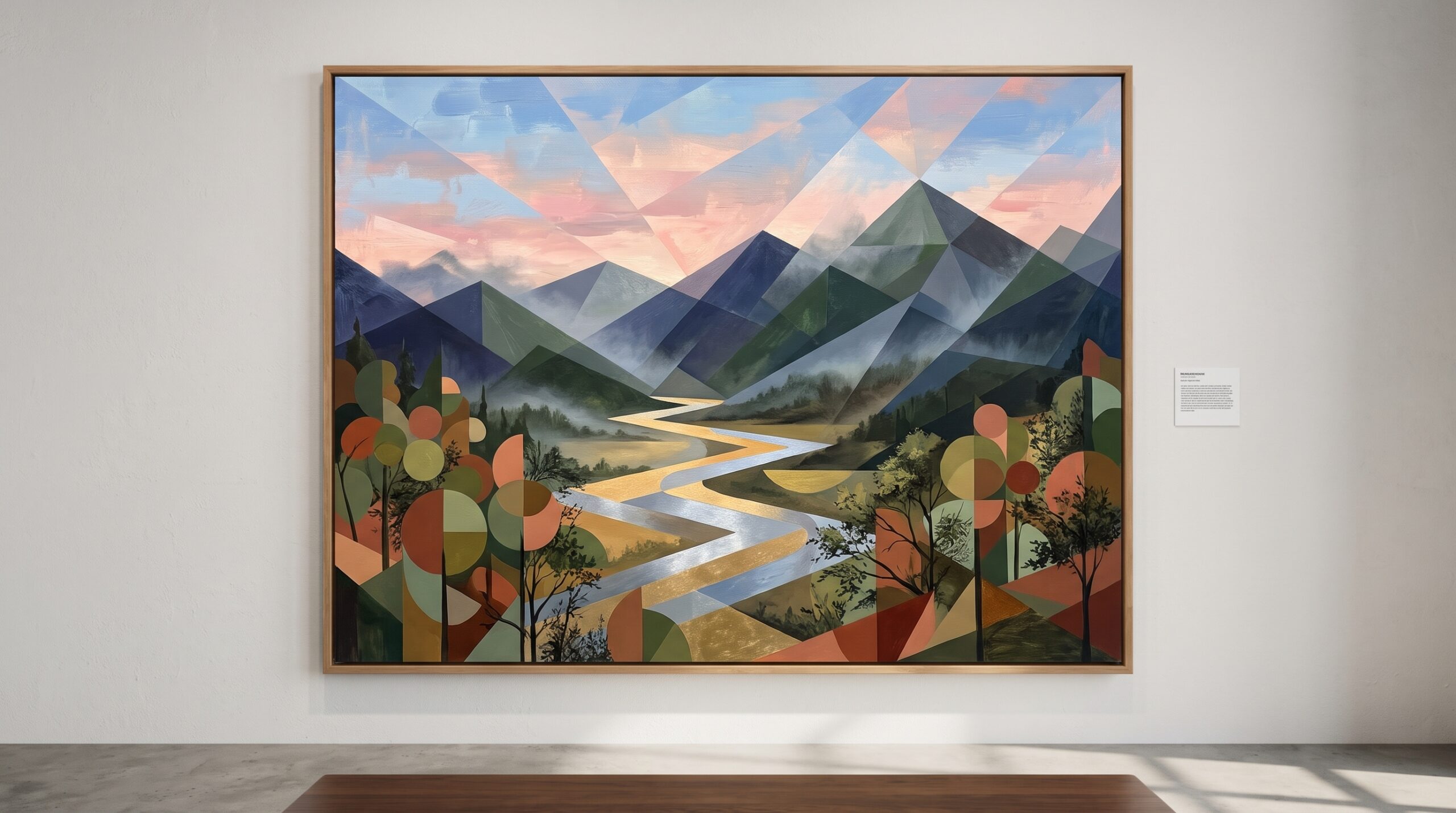
Walk into almost any contemporary gallery today and you might notice something unexpected: paintings where rolling hills dissolve into crisp triangles, where horizons are fractured into neon bands, and where the soft romance of landscape art collides head-on with the hard edges of geometric abstraction. This fusion isn’t a passing trend — it’s reshaping how artists and collectors think about two of the oldest genres in art history.
Geometric abstraction and landscape painting were, for most of the twentieth century, considered opposites. One celebrated pure form, color, and non-representational structure; the other clung to depicting the natural world. But a growing movement of painters is proving that the two can coexist — and that their collision produces something entirely new. This article explores how that visual language works, why it resonates right now, and how artists at any level can experiment with it in their own practice.
What Exactly Is Geometric Abstraction?
Geometric abstraction is a form of abstract art built on non-illusionistic shapes — circles, squares, triangles, lines — arranged in deliberate compositions. Its roots trace back to the early 1900s, with pioneers like Kazimir Malevich, Piet Mondrian, and the Constructivists arguing that art didn’t need to represent anything to be meaningful. A red square, Malevich famously claimed, could carry as much emotional weight as a portrait.
The movement evolved through the twentieth century via De Stijl, the Bauhaus, and later movements like Op Art and Minimalism. What unites these styles is a commitment to:
- Clarity of form — clean edges, defined shapes, intentional composition
- Flat color planes — often unmodulated, bold, and graphic
- Mathematical or systematic thinking — grids, repetition, symmetry, or deliberate asymmetry
- Rejection of depth — an embrace of the flatness of the canvas rather than the illusion of space
That last point is crucial, because landscape painting is built on almost the exact opposite principle: the illusion of depth. Which raises an obvious question — how can the two possibly merge?
How Traditional Landscape Painting Works
Traditional landscape painting, whether you look at the Hudson River School, French Impressionism, or Japanese ink painting, relies on a toolkit designed to convince the eye it’s looking into space:
- Atmospheric perspective — distant objects become lighter, bluer, and less detailed
- Linear perspective — converging lines pull the viewer toward a vanishing point
- Organic, irregular forms — trees, clouds, and water resist geometric description
- Naturalistic color — palettes drawn from observed reality
For centuries, mastery of these techniques was the measure of a landscape painter. But by the mid-twentieth century, artists began questioning whether “realism” was the only honest way to depict nature. After all, our actual experience of a landscape is rarely a postcard view. It’s fragmented — glimpsed through windows, refracted in water, remembered as impressions rather than photographs.
Where the Two Worlds Collide
The fusion of geometric abstraction and landscape painting didn’t happen overnight. It emerged gradually as artists began asking: what if the underlying structure of nature is geometric?
This isn’t actually a radical idea. Paul Cézanne — often called the bridge between Impressionism and Cubism — famously advised painters to “treat nature by means of the cylinder, the sphere, the cone.” He saw that a mountain could be understood as a triangle, a tree trunk as a cylinder, an apple as a sphere. Cubists like Picasso and Braque took this further, fracturing landscapes into faceted planes.
Today’s geometric landscape painters inherit this lineage but push it in new directions. Common approaches include:
1. The Segmented Horizon
Artists divide the canvas into horizontal bands — sky, treeline, water — but render each band as a distinct geometric zone. The result reads instantly as a landscape, yet each section operates with abstract logic: gradients, stripes, or solid color blocks replace painterly brushwork.
2. The Faceted Form
Mountains, hills, and rock formations are natural candidates for geometric treatment. Artists like those in the contemporary “low poly” aesthetic — inspired by early 3D computer graphics — render terrain as interlocking polygons, creating landscapes that feel simultaneously digital and timeless.
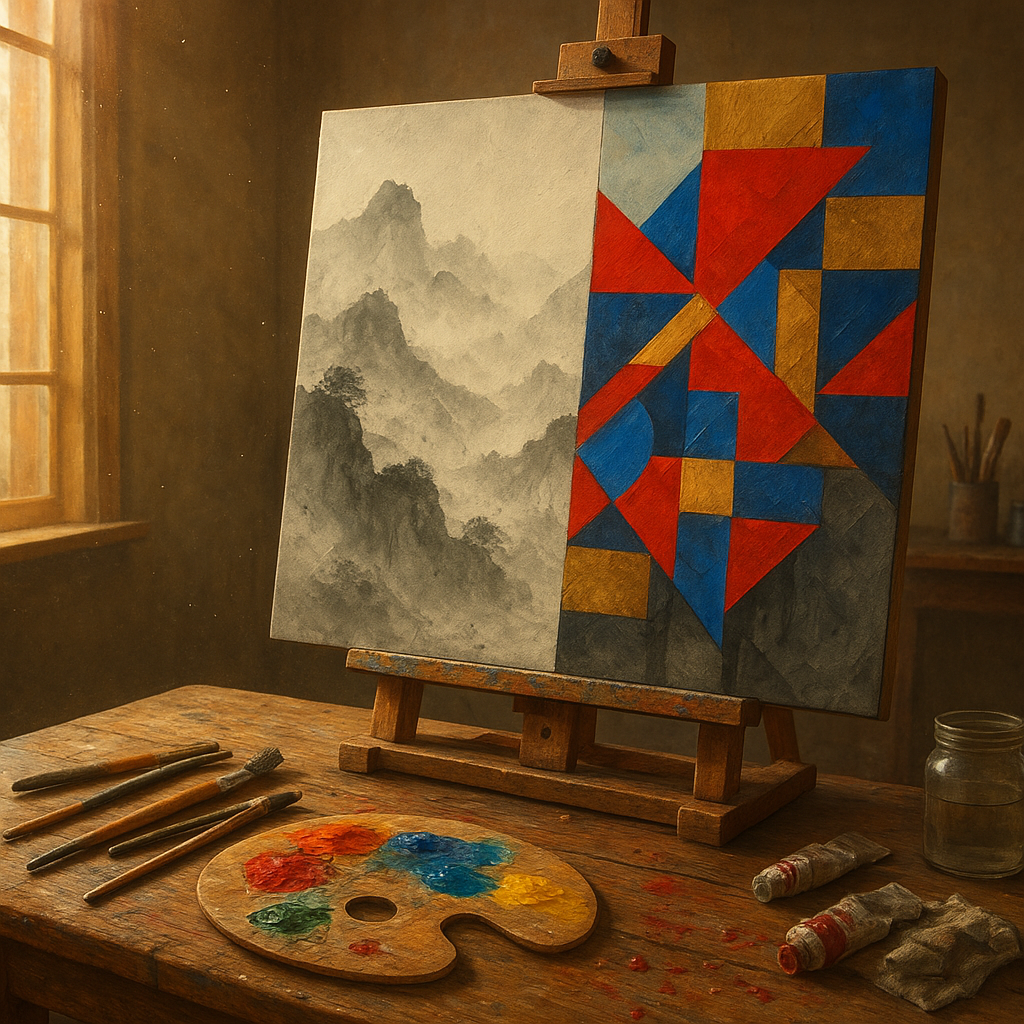
3. The Overlay Method
Some painters begin with a fairly traditional landscape, then superimpose geometric structures: circles eclipsing a sunset, diagonal lines slicing across a forest, or a rigid grid partially obscuring a meadow. The tension between the organic underlayer and the mathematical overlay becomes the subject itself.
4. The Color Field Landscape
Borrowing from Mark Rothko and the Color Field painters, some artists reduce landscapes to two or three expansive zones of color — a deep blue upper canvas suggesting sky meeting a warm earth-toned lower canvas. The viewer’s mind completes the landscape from minimal cues.
Why This Hybrid Style Resonates Right Now
There’s a reason this aesthetic has surged in popularity over the past decade. Several cultural currents converge here:
The digital-native eye. People raised on screens, interfaces, and pixel-based imagery process geometric visual language intuitively. A 2021 survey by Artsy found that abstract works were among the most in-demand categories for collectors under 40, and the geometric aesthetic of app design and digital illustration has clearly fed back into painting.
The modern interior. Minimalist and mid-century modern interiors — which dominate design trends — pair naturally with artwork that has strong shapes and controlled palettes. Geometric landscapes offer the warmth of nature imagery with the graphic punch that contemporary spaces demand. Artists seeking harmony between simplicity and expression might explore blending minimalism with expressive brushwork to enhance this balance.
A new relationship with nature. As climate consciousness grows, many artists feel that romantic, untouched-vista landscape painting no longer reflects reality. Geometric fragmentation can express a mediated, human-altered relationship with the environment — nature seen through satellite images, drone footage, and data visualizations.
Accessibility for painters. Honestly assessing the techniques: geometric forms are more forgiving than atmospheric realism. An intermediate painter can achieve striking results with masking tape, a limited palette, and careful planning, whereas a convincing traditional landscape might take years to master.
How to Create Your Own Geometric Landscape: A Practical Framework
If you’re a painter curious about this style, here’s a process that works across media — acrylic, oil, gouache, or digital.
Step 1: Start With a Real Landscape
Choose a reference photo or plein air scene. Don’t skip this step — even highly abstract geometric landscapes benefit from a real-world anchor. Squint at your reference until details blur and you see only major shapes: the mass of the mountain, the wedge of the lake, the band of sky.
Step 2: Reduce to Five to Seven Shapes
Sketch the scene using only simple geometric forms. Force each element into a triangle, rectangle, circle, or trapezoid. This is harder than it sounds — the discipline is in deciding what to sacrifice. A winding river might become a diagonal band; a cluster of trees, a single green triangle.
Step 3: Build a Limited Palette
Geometric abstraction thrives on color restraint. Choose four to six colors maximum. A reliable formula: two neutrals, two earth tones, and one high-chroma accent (a hot coral, an electric teal). Analogous color schemes create harmony; complementary accents create focal tension.
Step 4: Use Hard Edges Intentionally
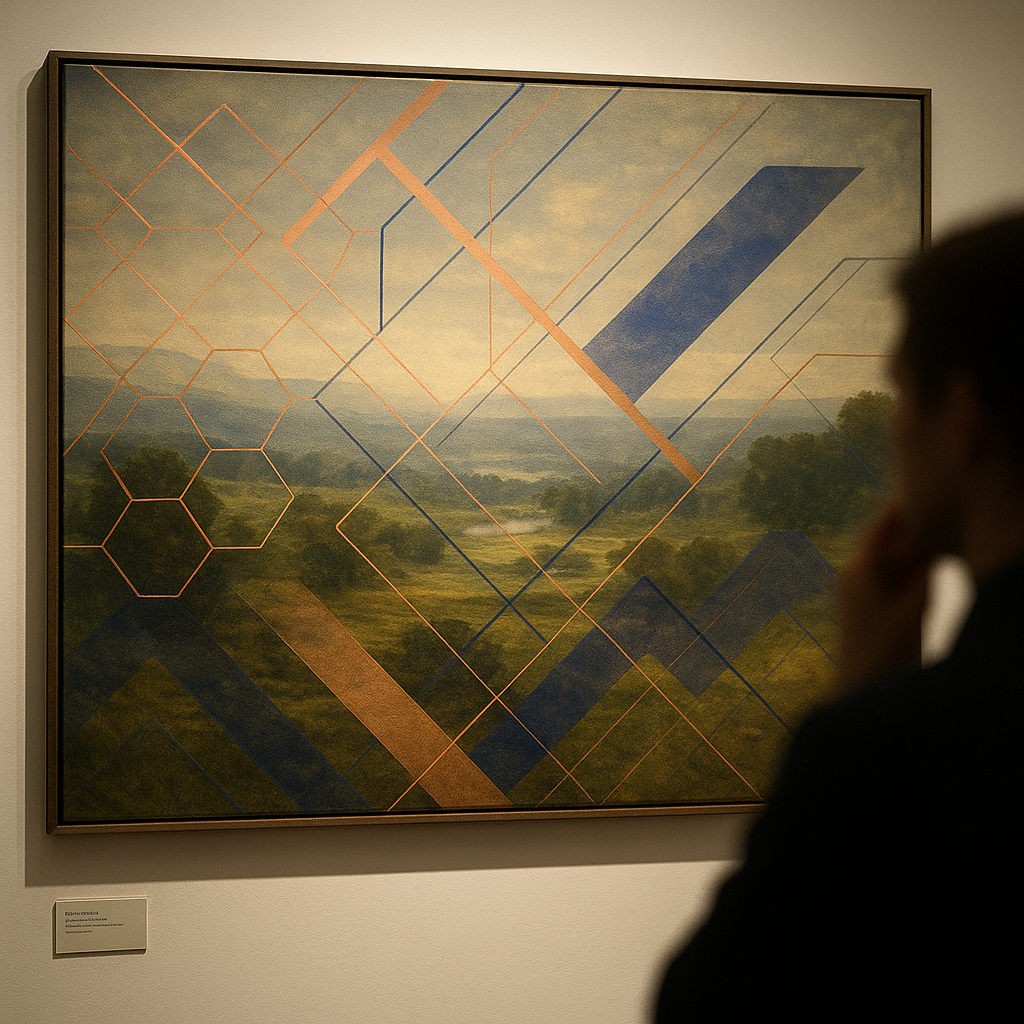
Masking tape is your friend here, but don’t tape everything — consider where soft edges might add life. A common strategy is keeping the sky soft and atmospheric while making the terrain crisp, which creates a compelling push-pull between the two languages. Pay attention to how natural light shapes the appearance of these edges throughout the day.
Step 5: Introduce One Disruption
The most interesting geometric landscapes contain a single element that breaks the system: a circle floating where no sun should be, a diagonal slash across the composition, one shape painted in a jarring color. This disruption gives the viewer’s eye somewhere to question — and questions are what make abstract work linger in the mind.
Step 6: Evaluate at a Distance
Geometric compositions succeed or fail at viewing distance. Step back frequently. If the composition doesn’t hold together from across the room, no amount of detail up close will save it.
Common Mistakes to Avoid
Even experienced painters stumble when first merging these styles. Watch out for:
- Overcomplicating the geometry — too many shapes create visual noise. Fewer, bolder shapes almost always win.
- Random color choices — geometric forms amplify color relationships, so weak palettes become painfully obvious.
- Losing the landscape entirely — if nothing reads as nature, you’ve simply made an abstract painting (which is fine, but different from the goal).
- Uniform edge quality — all-hard edges can feel sterile; consider varying your edge treatment strategically.
Frequently Asked Questions
What is the difference between abstract and geometric landscape painting?
Abstract landscape painting is a broad category covering any non-realistic interpretation of nature, including loose, gestural, expressionist styles. Geometric landscape painting is a subset that specifically uses hard-edged shapes and structured composition. All geometric landscapes are abstract, but not all abstract landscapes are geometric.
Do I need to know traditional landscape painting first?
Not strictly, but it helps enormously. Understanding how light, atmosphere, and depth work in traditional landscape painting gives you a stronger foundation to abstract from. That said, many successful geometric painters came from graphic design or illustration backgrounds and never trained in traditional plein air methods.
What medium works best for geometric landscapes?
Acrylic is the most popular choice because it dries quickly and works well with masking techniques. Gouache offers beautiful flat matte color. Oils require more patience with edge control but offer richer color depth. Digital tools like Procreate make experimentation nearly frictionless.
Is geometric landscape painting considered “serious” fine art?
Absolutely. The lineage runs through Cézanne, the Cubists, artists like Nicholas Roerich and Georgia O’Keeffe (whose later work leaned increasingly geometric), and continues with critically celebrated contemporary painters. Gallery representation and museum collections in this style have grown steadily.
Conclusion
The meeting of geometric abstraction and traditional landscape painting isn’t a gimmick — it’s a genuine evolution in how artists translate the natural world onto canvas. By borrowing the structural discipline of geometric art and applying it to humanity’s oldest painted subject, contemporary painters have developed a visual language that feels both ancient and unmistakably modern.
For artists, the style offers a practical framework: reduce nature to essential shapes, limit your palette, master hard edges, and introduce one element of disruption. For collectors and enthusiasts, it offers artwork that bridges decorative appeal and conceptual depth. And for the tradition of landscape painting itself, this fusion proves the genre is far from exhausted — it’s simply learning to speak in a new geometry.