
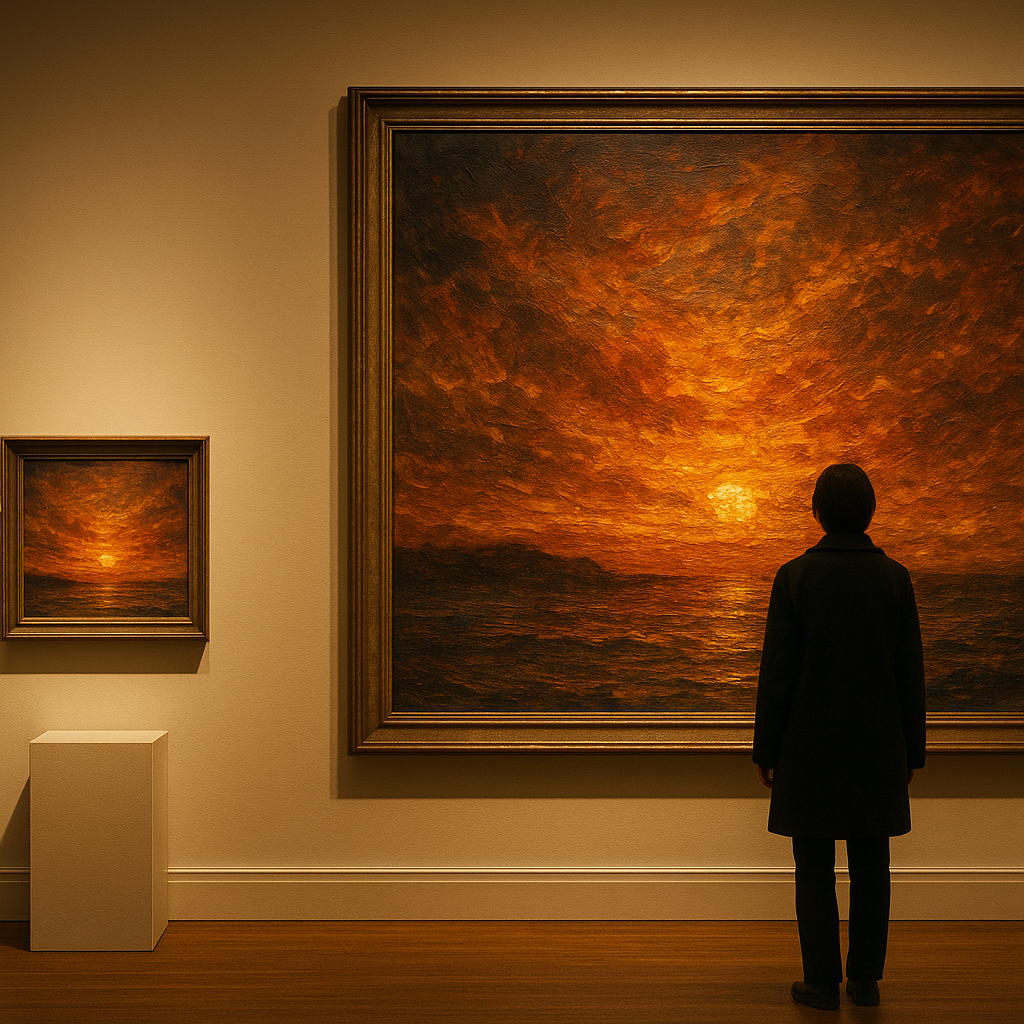
There’s a moment in art history that stops almost every student in their tracks: standing in front of Barnett Newman’s Vir Heroicus Sublimis at MoMA. The painting stretches nearly 18 feet wide. It doesn’t just hang on the wall — it consumes your field of vision. That experience isn’t accidental. Newman insisted viewers stand close, letting the canvas swallow them whole. The scale wasn’t decorative — it was the message.
Scale is one of the most powerful and least discussed tools in a visual artist’s arsenal. It influences how we feel about a piece before we’ve even consciously analyzed it. It can make the ordinary feel monumental, the familiar feel strange, and the abstract feel intensely personal. Whether you’re creating a tiny watercolor or a sprawling mural, understanding scale — and making deliberate choices about it — separates thoughtful art from accidental art.
What Is Scale in Visual Art?
In its most straightforward definition, scale in art refers to the size of one element in relation to another. It can describe the relationship between objects within a composition, or the relationship between the artwork itself and the human body that’s meant to experience it.
Scale is closely related to proportion, but they’re not the same thing. Proportion refers to the relative size of parts within a single object or figure — the ratio of a head to a body, for example. Scale is broader. It describes how sizes relate across different objects, figures, or the entire work itself in context.
There are generally two ways artists talk about scale:
- Hierarchical scale: Figures or objects are sized according to their symbolic or narrative importance, not their real-world dimensions. This was common in ancient Egyptian and medieval European art.
- Realistic scale: Elements are sized to reflect how they would appear in the real world, often used to create believable spatial depth.
But beyond these categories, contemporary artists use scale in far more experimental ways — deliberately breaking expectations to provoke emotional or intellectual responses.
Why Is Scale Important in Art?
Scale matters because human perception is deeply tied to physical size. We are embodied creatures — our understanding of the world is always filtered through the scale of our own bodies. When art plays with that scale, it plays directly with our psychology.
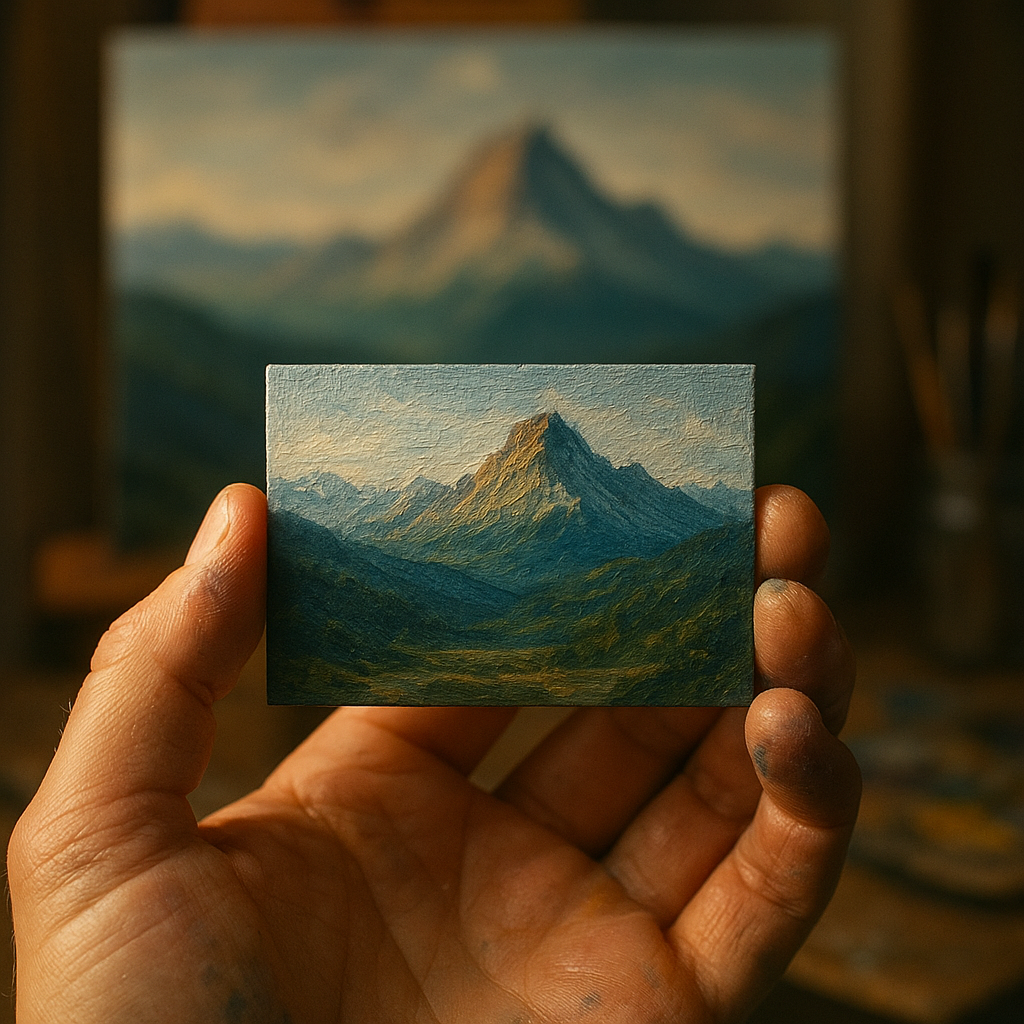
A towering sculpture makes us feel small, possibly humbled or even threatened. A miniature painting invites us to lean in, to peer closely, to feel like we’re being let in on a secret. Neither response is more “correct” — they’re just different, and artists choose scale precisely to trigger one response over another.
Research in environmental psychology consistently shows that spatial scale affects our emotional state. Larger spaces — and by extension, larger-scale works of art — tend to evoke feelings of awe, freedom, or even anxiety. Smaller, more intimate scales encourage feelings of warmth, curiosity, and focused attention.
For artists working in any medium, scale is therefore not a neutral decision. It’s an emotional one.
Scale and Viewer Experience
Think about how differently you experience art depending on its size. A reproduction of Michelangelo’s Sistine Chapel ceiling in a textbook versus standing in the actual chapel — the knowledge might be the same, but the experience is entirely different. The overwhelming scale of the original is, itself, the point. It was designed to make you feel the weight of something larger than yourself.
The same principle applies to smaller works. Joseph Cornell’s shadow boxes are rarely larger than a shoebox, but they create entire universes within those tight dimensions. The miniature scale transforms found objects into something precious and mysterious. If those same objects were arranged at life-size, the magic would dissolve.
Scale in Art Examples Through History
Understanding how artists have used scale across different periods helps illustrate just how versatile — and intentional — this element can be.
Hierarchical Scale in Ancient and Medieval Art
In ancient Egyptian tomb paintings, pharaohs are depicted significantly larger than servants, soldiers, or common citizens. This wasn’t a failure of perspective — it was a statement of cosmic hierarchy. The size of a figure communicated social and divine status. Medieval European religious paintings used the same technique: Christ, the Virgin Mary, and important saints appear larger than ordinary figures in the same scene.
This approach to scale tells viewers immediately who matters most in the composition’s narrative world. It’s a visual language that functioned effectively for thousands of years.
Renaissance Realism and Spatial Logic
The Renaissance brought a shift toward naturalistic scale, driven by the development of linear perspective. Artists like Leonardo da Vinci and Raphael began depicting figures and objects at sizes that reflected their actual position in three-dimensional space. Objects further away appear smaller; those in the foreground appear larger. Scale became a tool for creating believable depth.
This wasn’t just a technical improvement — it represented a philosophical shift toward human-centered observation of the natural world.
Scale as Subject in Modern and Contemporary Art
By the 20th century, artists began treating scale itself as subject matter. The Abstract Expressionists, including Mark Rothko and Franz Kline, created enormous canvases not to depict grand scenes but to produce overwhelming sensory experiences. Rothko famously said he wanted his large color field paintings to create an intimacy — not to overwhelm, but to engulf the viewer so completely that the experience became personal.
On the opposite end, artists like Charles and Ray Eames explored the philosophical implications of scale in their 1977 film Powers of Ten, which zoomed from the cosmic to the subatomic, demonstrating how radically meaning changes depending on the scale of observation.
More recently, artists like Jeff Koons have used monumental scale to comment on consumer culture — his enormous balloon animal sculptures in stainless steel force viewers to confront the absurdity of the objects they’re made to resemble.
Types of Scale in Art and How They Function
It’s useful to think about scale in art as operating on several levels simultaneously:
- Physical scale: The actual dimensions of the artwork itself — how big or small it is as an object in the world.
- Internal scale: The size relationships between elements within the composition — figures, objects, negative space.
- Contextual scale: How the artwork relates in size to the space it occupies — a small painting in a large gallery, or a mural filling an entire building facade.
- Psychological scale: The perceived size — how large or small something feels due to surrounding elements, color, lighting, or implied depth.
A skilled artist considers all four of these simultaneously. A painting might be physically small but create a sense of vast psychological scale through its use of perspective and color. Conversely, a large canvas can feel claustrophobically tight if the internal composition is dense and compressed.
Scale and Proportion in Art: Understanding the Relationship
While scale deals with size relationships across the whole composition or between the work and its viewer, proportion focuses specifically on internal relationships within objects or figures. The two concepts work together — you can’t discuss one meaningfully without the other.
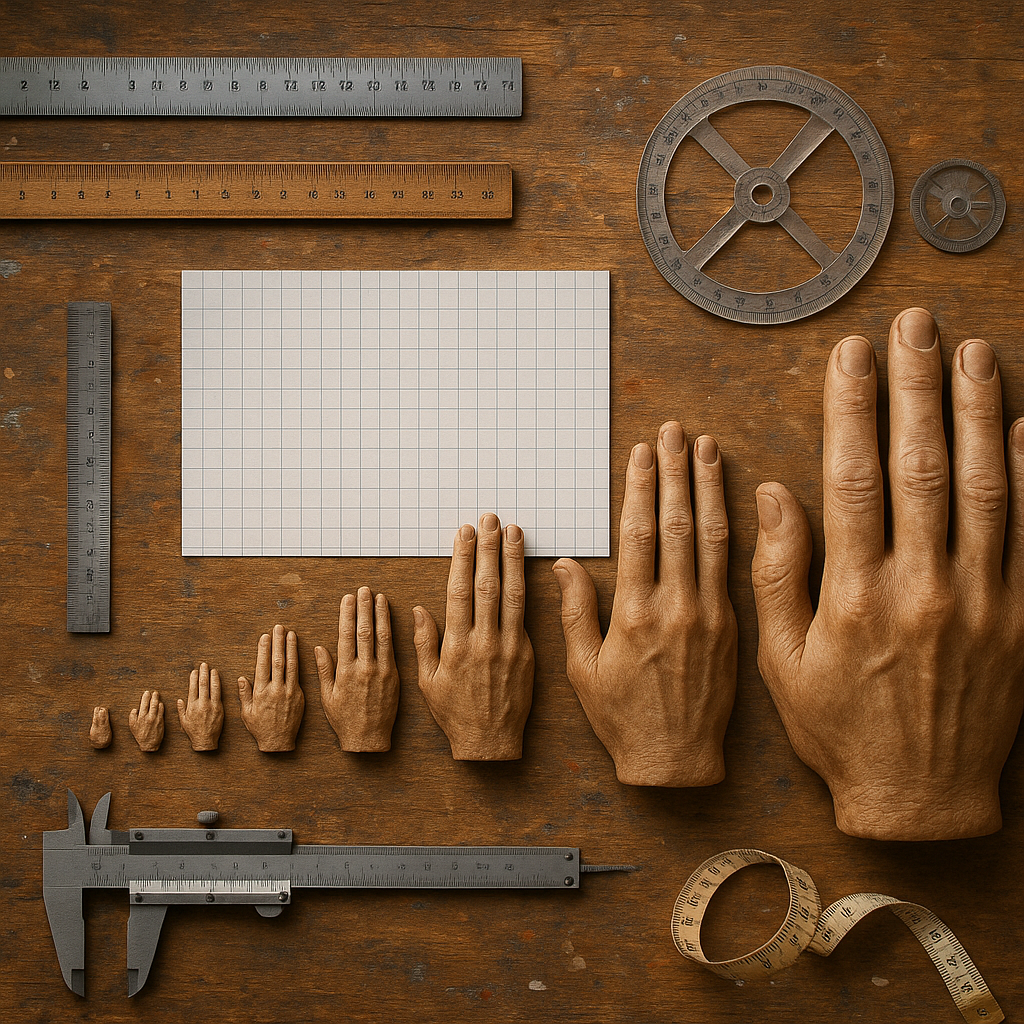
In figurative art, proportion has historically been governed by systems of ideal measurement. The ancient Greeks developed the concept of the “golden ratio” — approximately 1:1.618 — as a guide for harmonious proportions. Renaissance artists codified ideal human proportions based on anatomical study, with Leonardo’s Vitruvian Man as the most famous example.
But artists have deliberately distorted proportion for expressive purposes throughout history. El Greco elongated his figures to create a sense of spiritual transcendence. Mannerist painters exaggerated limbs and poses to produce tension and unease. Modern artists like Amedeo Modigliani stretched necks and faces into elegant, impossible forms. In each case, the distortion was purposeful — the departure from “correct” proportion carried meaning.
How Does Visual Art Scale?
Visual scaling — the way size is used to create the perception of depth and space — is one of the most fundamental techniques in two-dimensional art. Because a flat canvas has no actual depth, artists use relative size to imply it. Objects that are meant to appear farther away are drawn smaller; those in the foreground are larger.
Beyond simple perspective, artists use overlapping forms, atmospheric haze, and color temperature to reinforce scale cues. Warm, saturated colors tend to advance visually — appearing closer — while cool, muted colors recede. These techniques work together to build convincing spatial scale on a flat surface. The way natural light influences perception can further amplify or soften these spatial illusions depending on how a work is displayed.
Practical Considerations: Scale in Your Own Art Practice
For artists working in any medium, making conscious decisions about scale can dramatically change the outcome of a piece. Here are some things worth considering before starting a new work:
- What emotional response do you want? Intimate and contemplative, or overwhelming and awe-inspiring? Let that guide your physical dimensions.
- Where will the work live? A piece destined for a small domestic space will be experienced very differently from one designed for a gallery or public installation. Scale should be considered in context.
- Are your internal proportions serving your intention? If a central figure feels too small within the composition, it may undermine the authority you want it to carry.
- Experiment before committing. Thumbnail sketches and scaled studies let you test different compositional relationships before committing to full size.
- Consider the unexpected. Deliberately mismatching scale — rendering a mundane object at monumental size, or depicting an epic landscape in miniature — can be a powerful conceptual tool. This kind of intentional disruption shares common ground with breaking compositional rules to generate stronger creative impact.
Many artists work instinctively with scale, but developing a more conscious vocabulary around it can open up new creative possibilities. Even small adjustments — enlarging a figure slightly, increasing the negative space around an object, or scaling up the entire work — can fundamentally change how a piece reads and feels.
Conclusion
Scale is one of those elements in visual art that operates partly below the level of conscious awareness. Viewers often feel its effects before they can name what’s happening — a vague sense of being dwarfed, or drawn in, or unsettled, that turns out to have everything to do with deliberate choices about size.
From the hierarchical scale of ancient Egyptian reliefs to the immersive canvases of Abstract Expressionism to the monumental public sculptures of contemporary artists, scale has always been a vehicle for meaning. It shapes emotional experience, communicates importance, creates spatial illusion, and positions the viewer in relation to the world depicted.
Understanding scale — how it differs from proportion, how it functions visually and psychologically, and how artists across history have deployed it — gives anyone who looks at or makes art a richer, more textured way of engaging with it. Size, it turns out, really does change everything.